28 AUGUST 2026

28 AUGUST 2026
For years, it seemed like the Australian property market could shrug off just about anything. Interest rate rises, COVID, tighter lending rules and political uncertainty all came along, yet every time someone confidently predicted a housing crash, the market had other ideas.
This time feels a bit different. Not because there’s one major issue weighing on the market, but because there’s a handful of them all happening at once. Higher interest rates, stubborn inflation, global instability, concerns around AI, job security and now the Federal Government’s latest tax changes have all chipped away at buyer confidence.
That’s certainly what we’re seeing here in Newcastle.
Homes are taking longer to sell, stock levels are creeping up and buyers are negotiating harder than they have in recent years. Buyers are still turning up at open homes, but there are fewer of them. The mood has changed too. Buyers are asking more questions, taking more time and thinking carefully before making an offer.
Six months ago, buyers felt like they had one shot. If they missed out on a property, they worried another one wouldn’t come along for weeks. Today, there’s a fair chance another suitable home will be listed next weekend. Once buyers realise that, they stop making rushed decisions.
That shift in buyer psychology makes a huge difference. It changes how buyers behave, how quickly they make decisions and ultimately what they’re prepared to pay.
From what we’re seeing, we’ve moved from a strong seller’s market to a much more balanced one. It would be fair to say that, in some price brackets, it has even become a buyer’s market. Buyers finally have a few more options and a little more confidence to negotiate. That doesn’t mean the market has fallen over, but it does mean the pendulum has swung.
At LaneCampos, we spend a good deal of our working week completing appraisals. It’s where we get to hear people’s plans and provide advice around timing, pricing and presentation.
Over the last couple of years, there has been a huge number of upgraders and downsizers with the same concern: “I’d love to move, but I don’t want to sell until I find something.”
In a booming market, your home might sell in a week, but then you’re competing against four or five other buyers for the next property. You celebrate getting an amazing price, only to give a big chunk of it back because you’ve had to overpay to secure your next home.
Today’s market changes that equation. Sellers may not achieve quite the premium they would have six months ago, but they may also buy their next home for less than they otherwise would have. Too many people only focus on the selling price. If you’re buying and selling in the same market, you need to look at both sides of the ledger.
If you’re in this category and waiting for a sign, this could be it.
If you do decide to sell in the months ahead, getting the sale method right is critical. In a hot market, auctions can produce outstanding results when you’ve got genuine competition. Two or three emotionally invested buyers can push the price well beyond expectations. But if there’s only one genuine buyer, the whole dynamic changes.
If you’ve been to many auctions lately, you won’t be surprised to find just one registered bidder, or none at all. That’s not because auctions are suddenly a bad way to sell. They still have an important place. But we don’t believe this is the market to be forcing every property through an auction campaign.
If there’s only one genuine buyer, we’d rather negotiate with them directly. It gives us time to answer questions, build confidence and make sure the buyer understands the value of the property instead of relying solely on the pressure of auction day.
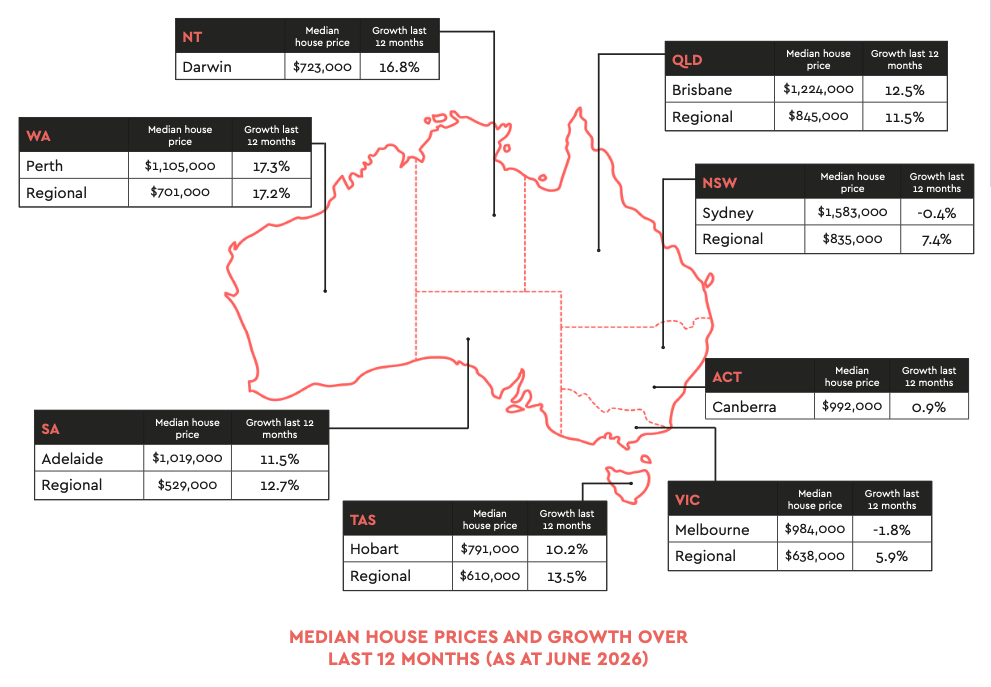
In terms of the numbers, national home values slipped by around 0.3% in June. What receives far less attention is that values are still almost 6% higher than they were a year ago. Sydney and Melbourne have softened the most, while many other capital cities have continued to grow, although at a slower pace.
Newcastle figures are rarely published and they’re also a little harder to measure because monthly sales volumes are lower. To work out how prices are changing, we rely on a rolling three month median.
For the three months ending June 2026, the median house price was $1,085,000, compared with $1,080,000 the previous month. That’s a modest increase of 0.4%.
The broader national data shows just how differently property markets around Australia are moving.
The last meaningful correction was back in 2022. Interest rates were climbing quickly after COVID. Confidence disappeared almost overnight and buyers became incredibly cautious.
This doesn’t feel like that.
Could the market soften a little more? Absolutely. Could prices drift lower over the next few months? Probably. But people still need somewhere to live. Families are still growing. People still separate, relocate for work, upsize, downsize and buy their first home. Life doesn’t stop because confidence takes a knock.
That’s one of the reasons downturns don’t last forever. Unlike shares or cryptocurrency, people don’t buy houses because they’re fashionable. They buy them because everyone needs somewhere to live.
If you’ve been waiting for the perfect time to make your move, we reckon it’s worth looking at today’s market a little differently.
Sellers may need to adjust their expectations, buyers will probably negotiate harder and properties may take longer to sell. But everyone has a little more breathing room to make good decisions instead of rushed ones.
Markets don’t ring a bell when the perfect time to buy or sell arrives.
They just evolve.
At LaneCampos, we feel that’s exactly what we’re seeing now.
Get the latest real estate tips and advice on buying, selling & investing on properties.